
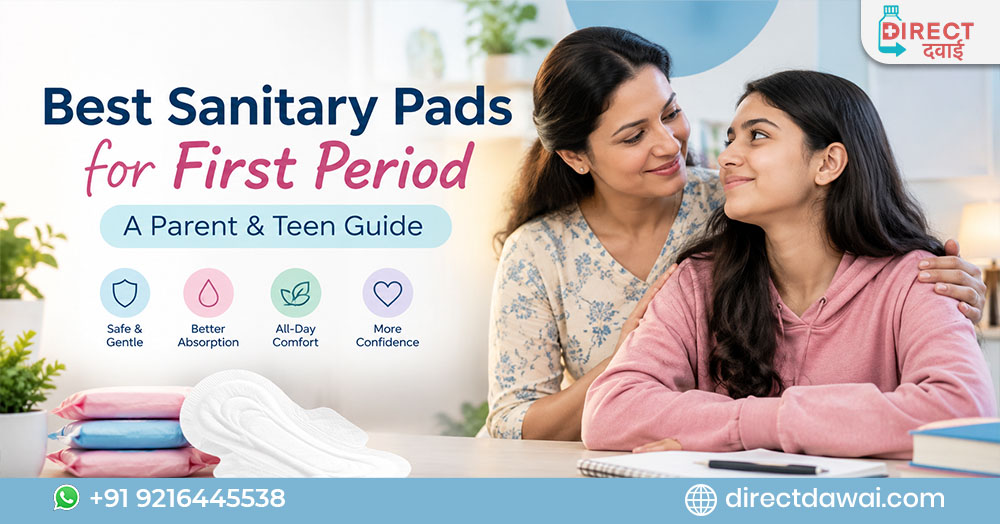
Best Sanitary Pads for First Period: A Parent & Teen Guide
Signs Your First Period Is Coming
Most girls notice body changes one to two years before the first period. But don’t panic because these are normal signs of puberty. So, usually, if you are in that phase, you will likely notice these early signs of your first period, including
-
Small breast buds under the nipples
-
Soft hair in the pubic area or underarms
-
Clear or white discharge in underwear
-
A sudden growth spurt
-
Mild mood swings, acne, or feeling more tired
But it is not like every girl will feel the same. Some girls also feel light lower-belly cramps a few days before. And the first bleeding can start with pink or brown spotting or go straight to red. Both are normal.
These signs help you get ready. Meanwhile, keeping a few pads at home and in a school bag can remove a lot of your worry about it. Also, if you want to know what the actual first period feels like and how long it usually lasts, you can read our detailed guide on this here-
Your First Menstrual Period: Signs, Timeline & Tips Every Teen Should Know
Best Sanitary Pads: What to Actually Look For
Then, once the signs show up, the next real question is which pad to actually pick. And honestly, this is where most first-timers, and a lot of parents, get overwhelmed by too many options on the shelf.
So, here's what genuinely matters when choosing the best sanitary pads for a first period-
-
Softness on the surface — the top layer should feel gentle, not plasticky or rough against sensitive skin.
-
Good absorption without bulk — thick doesn't always mean better. So, a pad that absorbs well while staying slim is usually more comfortable for daily wear.
-
Wings for grip — these keep the pad in place, especially important for someone still getting used to how a pad sits.
-
Breathable material — reduces irritation, especially when it comes to sanitary pads for teenage girls whose skin can be more reactive than an adult's.
-
Unscented over scented — this one matters more than people think. Because when it comes to unscented vs scented sanitary pads, unscented is almost always the safer starting choice. It’s because added fragrance can cause irritation or allergic reactions, especially on skin encountering a pad for the very first time.
Meanwhile, if you're a parent reading this before the conversation happens, this is also a good moment to think about how to talk to your daughter about her first period. You can go further like this-
Keep it simple, calm, and matter-of-fact, rather than turning it into a big deal. Because a serious sit-down usually makes her feel far more comfortable asking questions later.
Pad Types Compared
Now, you need to understand that not all pads are built for the same moment. So, here's a quick breakdown to help you understand what can work better for you during your periods for the first time.
|
Pad Type |
Best For |
Why It Works |
|
Regular pads |
Daytime, light to medium flow |
Balanced absorption for everyday use |
|
Overnight pads |
Sleeping through the night |
Longer length and higher absorption to prevent leaks |
|
Thin/ultra-thin pads |
Light flow days, first-time comfort |
Slim, less bulky, easier to get used to |
|
Organic cotton pads |
Sensitive skin |
Free from synthetic top layers, gentler overall |
|
Winged pads |
Active days, school hours |
Extra grip and security during movement |
Important note: For a first period specifically, overnight sanitary pads for periods are genuinely worth keeping at home from day one. It’s because flow can be unpredictable in the beginning, and nobody wants a surprise at 3 a.m.
Best Sanitary Pad Brands to Explore for First-Time Users
Rather than chasing one specific brand name, it's more useful to know what category to look for. Like for a first-time user, start with a brand that clearly labels itself as gentle, dermatologically tested, or designed for sensitive skin. And to be honest, most major Indian pad brands now offer a specific "thin" or "beginner" line built exactly for this stage.
So, reading the pack for "unscented," "cottony-soft top layer," or "hypoallergenic" is a more reliable filter than picking based on packaging alone. Meanwhile, if cost is a factor, most reputable brands also sell smaller trial packs before the full-size version, a genuinely smart way to test comfort and fit before committing to a larger pack.
You can try the following brands and their products-
|
Brand |
Product |
Estimated Price |
|
Whisper |
Whisper Ultra Clean |
₹68-₹200 (10-15 pcs) |
|
Stayfree |
Stayfree Dry Max |
₹105-₹190 (14-18 pcs) |
|
Sofy |
Sofy Anti-Bacteria |
₹190-₹220 (28 pcs) |
|
Nua |
Nua Sanitary Pads |
₹189-₹230 (12 pcs) |
|
Paree |
Paree Super Soft |
₹150-₹200 (30 pcs, approx.) |
|
Carmesi |
Carmesi Sensitive |
₹250-₹300 (30 pcs, approx.) |
|
Bella |
Bella Herbs |
₹119-₹150 per pack (approx.) |
|
Vwash |
Vwash Wow |
₹58-₹185 (5-16 pcs) |
|
PeeSafe |
PeeSafe 100% Organic |
₹250-₹300 (10-20 pcs) |
|
Triya |
Triya Sanitary Pads |
Price varies by pack size. That’s why check the current listing |
Important note: Prices are approximate and vary by pack size, retailer, and ongoing offers. That’s why make sure to check the current listing before buying every single time.
How to Use a Sanitary Pad for the First Time
Now, this is the part that feels the most intimidating, but it really doesn't need to be. So, here's how to use a sanitary pad for the first time, step by step-
-
Unwrap the pad and peel off the paper backing to expose the sticky side.
-
Press the sticky side onto the center of your underwear, lengthwise.
-
If the pad has wings, fold them under the underwear on each side and press to stick, this keeps it from shifting.
-
Adjust so the pad sits centered and flat, not bunched up.
-
Wear normally, and change it on schedule (more on that below).
That's genuinely the whole process. And yes, there's no wrong way to press it down as long as it feels secure and centered.
How to Choose Between a Pad and a Tampon
For a first period specifically, most doctors and parents recommend starting with pads. Because when it comes to pad vs tampon for first period, pads are simply easier to learn with- no internal insertion, no learning curve. And on top of that, they're easier to check visually to know when a change is needed. On the other hand, tampons can be introduced later, once someone's comfortable with their body and cycle, but there's genuinely no rush to get there.
How Often to Change a Pad
Now, this is also one of the most searched and most quietly worried-about questions out there. So, the general rule for how often to change a pad is every 4 to 6 hours, regardless of how full it looks. Even on lighter days, pads should still be changed within that window. It’s because bacteria can build up on a pad left too long, which is more about hygiene than absorption capacity.
Meanwhile, on heavier flow days, or overnight, that window can shrink to every 3-4 hours during the day. Just follow this simple habit: Change it before school, at lunch, after school, and before bed. Because four checkpoints are an easy rhythm to remember without overthinking it.
When to Talk to a Doctor
Most first periods, and the months that follow, are completely normal, even when they're irregular. But it's worth checking in with a doctor if:
-
Periods haven't started by age 15-16
-
Bleeding is extremely heavy, soaking a pad within an hour, repeatedly
-
Periods cause pain severe enough to affect daily activities
-
There's no period at all for several months after the first one started
Irregular cycles in the first year or two are usually just the body adjusting, not a red flag on their own. So, if her periods start feeling unpredictable a few months in, our guide on why periods get delayed breaks down what's actually normal and what's worth getting checked.
Conclusion
Therefore, we can say that a first period doesn't need to be a big, scary event. It's just a normal part of growing up that goes a lot smoother with the right information ahead of time. And knowing the best sanitary pads to reach for, understanding how and when to change one, and having an open, calm conversation beforehand makes all the difference between panic and simply handling it. Just make sure to keep a few pads on hand, keep the conversation ongoing rather than a one-time talk, and let the rest come naturally.
Disclaimer: This article is for general information and educational purposes only. It is not medical advice. Every body is different. So, if you or your daughter have concerns about periods, heavy bleeding, pain, or delayed cycles, please consult a qualified doctor or gynaecologist for personalised guidance.
FAQs
-
Which pad brand is the best?
There is no “best” brand, because the right one for you depends on your flow, your skin sensitivity, and what feels good on your body. But yes, in general, soft, fragrance-free pads with wings work well for most people, like Nua and Carmesi.
-
What pads do gynecologists recommend?
Gynecologists usually suggest unscented, soft pads that do not irritate the skin. Many also prefer cotton-top or organic options for sensitive skin and recommend changing them every 4–6 hours.
-
Which is better, Nua or Sofy?
Neither is better. It just depends on your convenience. Take Nua, for instance, which is often the pick for sensitive skin because it’s fragrance-free and marketed as toxin-free. Meanwhile, Sofy is famous for good absorbency and antibacterial properties. If you can, try both, since comfort is personal.
-
Which sanitary pad is safe to use?
In general, any unscented pad, doesn’t contain harsh chemicals or strong fragrance, and doesn’t cause itching or redness is fine. But change it regularly and go for one that feels soft against your skin.
-
Which is the No. 1 sanitary pad?
There is no official No.1, though, but popular, reliable options in India include Whisper, Sofy, Nua, and Stayfree. Still, the best is the one that stays in place, absorbs well, and does not irritate you in any way.
-
Which pad is best during periods?
A soft pad with wings that matches your flow. It’s like you can consider regular or thin pads for light-to-medium days. While go with longer overnight pads for heavier flow or nighttime.
-
How do I decide which size to get?
Start with regular or medium for first periods or average flow. Go longer (XL or overnight) if you have heavy days or want extra coverage at night. But make sure to check the length printed on the pack if possible.
-
Are organic pads better?
They are often more gentle on sensitive skin and usually contain fewer fragrances, dyes, and harsh chemicals. But not everyone needs them, only people with irritation prefer them.
-
What does “Wider Back” mean in pads?
It means the back part of the pad is broader. It is something that helps catch flow that moves backwards when you sit or lie down, reducing leaks at night or while sitting.
-
Do sanitary pads need to be dermatologically tested?
It is not mandatory by law in most places, but many good brands do get them tested. That’s why try to look for “dermatologically tested” or “for sensitive skin” on the pack if you have reactive skin.

-150x150.webp "Your First Menstrual Period: Signs, Timeline & Tips Every Teen Should Know")

Leave your comment
Note: HTML is not translated!