
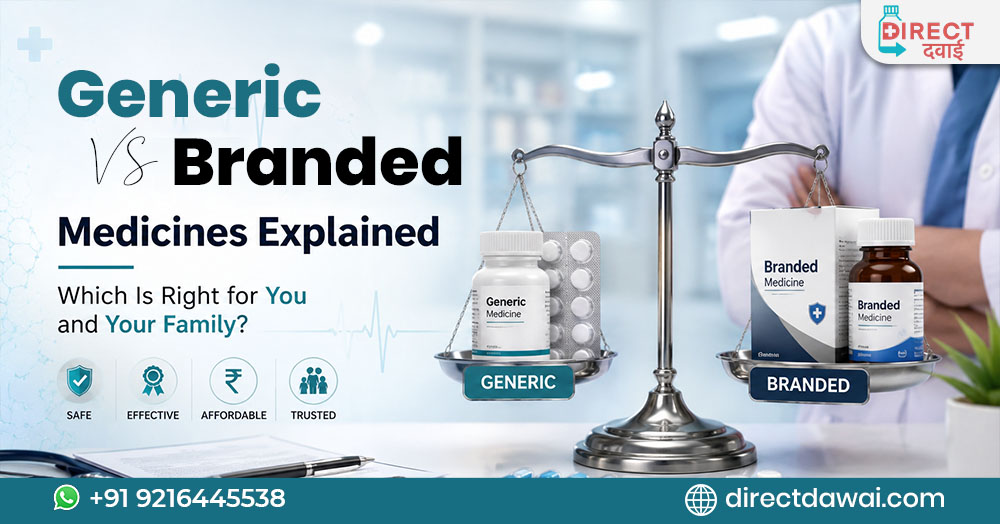
Generic vs Branded Medicines Explained: Which Is Right for You and Your Family?
What Are Branded Medicines?
A branded medicine is the version a pharmaceutical company sells under its own trademarked name, usually right after developing and patenting a new drug. That company spends years and often crores of rupees on research, clinical trials, and marketing before the medicine ever reaches a pharmacy shelf. That’s why, to recover that investment, branded medicines are priced significantly higher. And a portion of what you pay covers the brand name, the packaging, and the marketing behind it, not just the medicine itself.
Once a drug's patent runs out, the exclusivity goes with it. That means other manufacturers can legally step in and make that exact same formula- no need to reinvent anything, because the hard part's already done. That's the moment generic medicines enter the picture.
What Are Generic Medicines?
So, generic medicines in India contain the same active ingredient, in the same strength and dosage form, as their branded equivalent. But they're manufactured after a drug's patent protection ends, which means the company producing them doesn't carry the original research and development costs, and that saving is passed almost entirely to you.
But here is a common misconception that "generic" means unbranded or low-quality. In reality, most generic medicines in India are still sold under a company name (often called "branded generics"), just without the premium pricing of the original patent-holder. Because what actually determines quality isn't the name on the box, it's whether the medicine meets India's regulatory standards or not.
Types of Generic Medicines in India
Now, in the Indian market, generics show up in two main ways:
-
Unbranded Generics (Pure Generics): Sold purely by their chemical name, like Dolo 650mg or Metformin 500mg, without any fancy brand packaging. These are common in government healthcare drives and Jan Aushadhi stores.
-
Branded Generics: Made by well-known pharmaceutical companies (like Cipla, Sun Pharma, or Torrent) and given a short brand name (like Ciplox for Ciprofloxacin). Even though they have a brand label, they are technically generic versions of the original off-patent drug.
“Key Market Insight: Research published by the National Center for Biotechnology Information (NCBI) shows that branded generics account for 70% to 80% of the domestic market for generic medicines in India.”
The Science: Active Pharmaceutical Ingredient & Bioequivalence, Explained Simply
Now let's talk about what's actually happening inside these tablets, because this is where most of the confusion clears up. Every medicine, branded or generic, is built around an active pharmaceutical ingredient, the real chemical compound doing the work of treating your condition.
Take paracetamol, for instance. A branded tablet and a generic one are both leaning on the exact same active pharmaceutical ingredient, at the exact same strength. What can differ is everything around it, like the binders, fillers, the coating, and the stuff that holds the tablet together but has nothing to do with how it treats you.
But here's the part that actually matters: no generic medicine gets to skip the hard part. Before it's approved, it has to pass a bioequivalence test. It is a study proving it's absorbed into the bloodstream at a comparable rate and extent as the branded version, within a scientifically accepted range.
And this is the real quality benchmark that matters, far more than packaging or brand recognition. It's a technical process, but the takeaway is simple: a generic medicine isn't a "cheaper guess" at the original, instead, it's held to a defined scientific standard before it can be sold at all.
|
BIOEQUIVALENCE TESTING PARAMETERS |
|
|
C_max (Peak Concentration) |
How much active drug hits your bloodstream. |
|
AUC (Area Under Curve) |
Total amount of active drug absorbed over time |
*Statistical Standard: Generic must match 80% to 125% of the branded benchmark.
Generic vs Branded Medicines: The Real Price Difference (India Data)
This is where the numbers get genuinely striking. A 2026 citizen-funded study conducted across regulated retail outlets in Kerala found generic medicines were, on average, 48.6% cheaper than their branded equivalents, with the most expensive branded products costing up to 13.9 times more than the lowest-priced generic version of the same molecule.
The gap widens further with India's Jan Aushadhi scheme, a government initiative selling generic medicines through dedicated outlets. According to a Lok Sabha reply from the Ministry of Chemicals and Fertilizers, Jan Aushadhi medicines run 50% to 80% cheaper than leading branded alternatives, and for some chronic disease medicines, savings go even higher.
And this is the core of the generic vs brand name drugs price difference: you're often paying multiples more for the exact same active ingredient, simply because of the name on the box.
Difference Between Generic vs Branded Medicines: Quick Comparison Table
Here's the whole comparison in one place so you can see everything together that exactly how generic and brand medicines differ from each other.
|
Factor |
Generic Medicines |
Branded (Non-Generic Medicines) |
|
Active Ingredient |
Same as the branded version |
Original formulation |
|
Name |
Sold by chemical name, or a manufacturer's own trade name (branded generic) |
Sold under a unique, trademarked brand name |
|
Price |
Usually lower, sometimes significantly |
Higher, reflects R&D and marketing costs |
|
Regulatory Approval |
CDSCO approved |
CDSCO approved |
|
Bioequivalence Testing |
Required before approval |
Original clinical trial data |
|
Manufacturer |
Multiple manufacturers, once patent expires |
The company that originally developed the medicine |
|
Appearance & Packaging |
Can be different in shape, colour, packaging, or size |
Go with original packaging and appearance |
|
Best Suited For |
Most everyday and chronic prescriptions |
Narrow therapeutic index drugs, doctor-specified cases |
Are Generic Medicines Safe and Effective?
This is usually the real question sitting underneath all the price talk — not "is it cheaper," but "is it just as good as the brand one?" And the honest answer is yes, for the vast majority of medicines, generic versions are just as safe and effective as their branded counterparts.
The reason comes down to how they're approved in the first place. A generic medicine has to prove its worth. That it holds the exact same active ingredient with the same strength as the brand one. And it can get absorbed easily into your body at a comparable rate to the branded version, before it ever reaches a pharmacy shelf.
Because here quality isn't something that gets relaxed just because the price is lower, it's checked, tested, and confirmed before approval, every single time. That’s why we can say that it’s only brand recognition that changes, not the effectiveness, and you can rely on generic medicines safely.
How CDSCO Regulates Generic Medicines in India
Here, nothing goes on by accident. Every generic medicine sold in India has to be approved by the Central Drugs Standard Control Organization (CDSCO). It is the national body responsible for drug approval, quality control, and safety oversight. Before a generic ever reaches the market, it has to prove bioequivalence to the branded version, follow good manufacturing practices, and pass quality testing. The same bar every medicine has to clear, whether it's generic or not.
So when you pick up a generic medicine in India, you're not taking a chance on something unverified. You're choosing a medicine that's already walked through the exact same regulatory door as the branded one sitting right beside it on the shelf.
Jan Aushadhi Medicines vs Branded Medicines: How the Government Scheme Works
Since affordable healthcare feels like something that depends on how much marketing budget a company has behind its medicine, the government built the Pradhan Mantri Bhartiya Janaushadhi Pariyojana (PMBJP). So, when you actually break down Jan Aushadhi medicines vs branded medicines, you will see the following differences and understand how exactly they work in comparison to the branded ones.
|
Feature |
Jan Aushadhi Generic Medicines |
Branded Medicines |
|
Who Runs It |
A public health initiative (PMBJP), run through the Pharmaceuticals & Medical Devices Bureau of India (PMBI) |
A private pharmaceutical company, doing everything from R&D to manufacturing to marketing |
|
What's Actually Inside |
The same active ingredient, working the same way in your body |
The same active ingredient, just under a trademarked name |
|
What You Pay |
Usually 50-80% less, since there's no brand-building cost baked in |
Noticeably a bit more, since you're also footing the bill for years of research and marketing behind it. |
|
How It Looks |
Plain packaging with the generic name printed on it, nothing fancy |
Polished, branded packaging designed to be recognizable on a shelf |
|
How It's Checked |
Sourced from WHO-GMP certified facilities and tested in NABL-accredited labs |
Goes through the standard CDSCO checks every approved medicine has to clear |
|
Where You'll Find It |
Only at dedicated Jan Aushadhi Kendras |
Pretty much any pharmacy, general or private |
Important note: Strip away the packaging and the storefront, because what's actually sitting inside both boxes doesn’t change. One version just costs less to reach you, because the government took the marketing budget out of the equation entirely. While the other simply charges it from you.
Common Myths About Generic Medicines
A lot of the hesitation people feel comes down to a handful of ideas that don't really hold up once you look closely. Like the following myths about generic medicines-
Generic means lower quality
Every generic sold in India goes through the same CDSCO bioequivalence and manufacturing checks as branded medicines.
Doctors secretly prefer branded medicines because they work better
Most doctors actually prescribe by salt name for this exact reason, so you or your chemist can choose either version comfortably.
They are less effective or take longer to work
Since generics carry the same active ingredient at the same strength and have to pass bioequivalence testing, they're expected to work just as fast and just as effectively as the branded version.
They cause more side effects
The active ingredient responsible for a medicine's effect, and its main side effects, is identical. What can occasionally differ is an inactive ingredient like a filler or dye. But that happens in rare cases and might affect someone with a specific sensitivity, regardless of whether the medicine is branded or generic.
They are made in poor facilities
Generic manufacturers in India are required to follow the same Good Manufacturing Practices as branded companies. In fact, many Jan Aushadhi and export-grade generics come from WHO-GMP certified facilities.
When Might a Branded Medicine Still Be the Better Choice?
None of this means generic is automatically the right call every single time. There are a few genuine situations where sticking with a specific branded medicine makes more sense, such as-
-
Narrow therapeutic index drugs — some thyroid or seizure medications fall into this category, where even small shifts in absorption can actually matter.
-
A doctor has flagged a specific formulation concern for you — sometimes there's a reason behind that advice worth trusting.
-
You've reacted before to a particular manufacturer's inactive ingredients — not the medicine itself, just what it's packaged with.
So, in these cases, consistency matters more than the savings, and your doctor's specific advice should always come before a general rule.
How to Safely Switch from Branded to Generic Medicines
Then, now, if you're wondering whether it's safe to switch to generic medicines for your regular prescriptions, the process is a lot simpler than people expect. You can go with the following steps-
-
Check the salt name, not just the brand, it's right there on your prescription or the medicine strip.
-
Talk to your doctor or pharmacist before switching, especially for anything long-term, so they can confirm there's no clinical reason to stay with your current brand.
-
Buy from a licensed source because proper storage and sourcing matter just as much as the manufacturer.
-
Pay attention to how you feel for the first few doses, the way you would with any new medicine, and flag anything unusual.
And if you think you’re ready to make the switch, you can buy generic medicine online through a pharmacy that actually verifies its sourcing and storage. So, in the end, the savings don't come with any hidden trade-off in how the medicine reaches you, like Direct Dawai.
Conclusion
So, in the end, the debate around generic vs branded medicines lets us come down to one simple realization: price and quality aren't the same thing in Indian pharmaceutical regulation. Every generic medicine sold legally here has cleared the same CDSCO bioequivalence and manufacturing bar as its branded counterpart. So, for most everyday and chronic prescriptions, choosing generic isn't a compromise, it's an informed way to spend a lot less without changing what the medicine actually does for you. Just keep your doctor in the loop before switching anything long-term, and let the decision come from your actual health needs, not habit.
Medical Disclaimer: This article is for informational purposes only and is not a substitute for professional medical advice. Always consult your doctor or pharmacist before switching between branded and generic medicines, especially for ongoing treatment.
Frequently Asked Questions
-
Is brand better than generic?
No, because both use the same active ingredient at the same strength. Branded medicines just cost more for the name, packaging, and marketing, not better effectiveness, except in a few narrow cases.
-
Why don't doctors recommend generic medicine?
Many doctors do recommend generics. But when they hesitate, it usually comes down to clinical caution, familiarity with a specific brand, or particular patient factors, not any real doubt about safety.
-
Can we trust generic medicine?
Yes, but honestly, that trust isn't blind, it's earned. Every generic sold in India has to be CDSCO-approved, which means proving it works in your body just like the branded version, and clearing the same manufacturing and quality checks along the way.
-
Which one is more expensive, generic or brand?
Branded medicines, hands down. Generics usually cost noticeably less, and Jan Aushadhi versions save you the most of all, simply because there's no marketing budget hiding inside the price.
-
Is it okay to buy generic medicine?
Yes, for most everyday and chronic medicines. Just buy from a licensed pharmacy, and check with your doctor before switching an existing long-term prescription.
-
Is Dolo a branded generic?
Yes, Dolo 650 is a branded generic made by Micro Labs Limited. And to be honest, paracetamol itself is just the plain, off-patent molecule sitting quietly behind the brand name.
-
Which generic medicine company is best in India?
No single official "best," but Sun Pharma, Cipla, Dr. Reddy's, and Lupin are consistently found among the largest and most trusted names over time.
-
Are Jan Aushadhi medicines good or bad?
Good, as they're WHO-GMP sourced and lab-tested, meeting the same quality standards as any approved medicine, just sold at steep government-subsidized prices.
-
How to identify generic medicine?
Check the label for the salt name. Because plain chemical-name packaging usually means an unbranded generic, while a shorter trade name attached to it means a branded generic. Along with that, look for CDSCO approval details and manufacturer info on the pack. But if you are not sure about it, ask your pharmacist to confirm as soon as possible.
-
Who is the largest manufacturer of generic drugs?
Sun Pharmaceutical Industries. It's India's biggest pharmaceutical company by revenue, and one of the world's leading generic drug makers to boot.
Sources
https://pmc.ncbi.nlm.nih.gov/articles/PMC8973766/
https://www.frontiersin.org/journals/pharmacology/articles/10.3389/fphar.2026.1799574/full



Leave your comment
Note: HTML is not translated!